
Nyhetsbrev
Prenumerera gratis på våra nyhetsbrev och inbjudningar till seminarier.
Prenumerera gratis på våra nyhetsbrev och inbjudningar till seminarier.

The war has deepened Ukraine’s demographic crisis and created major challenges for the country’s labour market. Millions of people have been displaced, while limited access to childcare and the unequal distribution of care responsibilities restrict many women’s opportunities to work and achieve economic independence. Strengthening women’s economic independence and creating better conditions for combining work and family life are therefore important parts of Ukraine’s reconstruction.
Through the project INTEGRATE – People First: Building a Gender-Equal and Inclusive Demographic Future for Ukraine, the Palme Center and Centre of United Actions will strengthen the capacity of Ukrainian authorities to integrate gender equality into labour market and social policy. Among other things, the project will help national and regional authorities better assess how policy decisions on issues such as childcare, parental leave and labour market measures affect women and men.
“Even in the midst of war, Ukraine is working towards its future and EU membership. We want to help ensure that gender equality, access to employment and economic independence become integral parts of the country’s reconstruction. By combining Swedish experience with the knowledge of our Ukrainian partners, we can contribute to concrete change,” says Oscar Ernerot, Secretary General of the Palme Center.
Over the course of the 18-month project, the organisations will assess the needs of public authorities, provide training and facilitate exchanges of experience with Swedish counterparts. The project will also produce practical guidance, including methods and tools that Ukrainian authorities can continue to use. In this way, the project will support the implementation of Ukraine’s National Demographic Strategy through 2040 and contribute to the country’s alignment with EU rules and standards on gender equality, employment and social policy.
Contact: Anh Helge, Region Representative, Eastern Europe, anh.helge@palmecenter.se
Stop the attacks on the LGBTQ+ community in Türkiye!
The extensive crackdown on LGBTQ+ organisations and human rights defenders in Türkiye is deeply alarming and unacceptable. Activists have been detained, the offices of organisations have been searched, and websites and social media accounts have been blocked. At the same time, organisations and their representatives are facing legal proceedings that risk further restricting their ability to operate.
This is not only an attack on the rights of LGBTQ+ people. When people are persecuted for organising and defending human rights, freedom of association, freedom of expression and the space for a free and democratic civil society are also under threat.
The Swedish Government and the EU Commission must respond clearly and stand up for those affected. Sweden and the EU should raise these developments directly with the Turkish Government and push for action within other international forums. Human rights defenders who have been detained for their legitimate work must be released, and the right of LGBTQ+ organisations to organise, speak out and operate freely must be defended.
We stand in solidarity with our former Turkish partner organisation KAOS GL, as well as with the Turkish member organisations of our partner ERA. ERA – the LGBTI Equal Rights Association for the Western Balkans and Türkiye – is a regional network that brings together and strengthens LGBTQ+ organisations in Türkiye and the Western Balkans, and works to advance human rights, equality and inclusion.
The sharp escalation in repression against the LGBTQ+ movement in recent days must not be met with silence – nor with reduced international support. As the space for civil society shrinks, solidarity and support for those who continue to defend democratic rights and freedoms are more important than ever.
Oscar Ernerot
Secretary General, Olof Palme International Center
Diana Ghafour
Chair, HBTQ+S
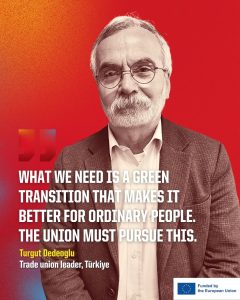
Trade union for journalists, publishing and printing house workers
“The climate crisis will affect workers the most, and we represent the workers. In addition, countries like ours are particularly vulnerable to the impacts, such as extreme heat.
Today’s politics primarily benefit those who hold capital. What we need is a green transition that improves the lives of ordinary people. Pursuing this must be the union’s mission.”
“Türkiye is a developing country. So whenever we bring up environmental issues, we are met with ‘Why do you oppose development?’. We need to communicate that this transition is fundamentally about securing jobs and protecting workers’ health.
While people in Türkiye are well aware of the climate crisis, they do not yet know what a ‘just transition’ looks like. As a union, we can help our members familiarize themselves with this concept so they can participate in how their workplaces evolve. Our own sector, the printing industry, will be heavily impacted by this transition. To get a clearer picture of the changes underway, we are currently preparing a report.
Furthermore, those of us who are journalists can directly report on the climate crisis; our roles is to inform the public. For instance, we can draw attention to laborers forced to work under extreme heat, which is becoming increasingly common. Being out in the field so much, we as media workers are also affected by this.”
“Yes. It is notoriously difficult for trade unions to put any issue on the agenda in Türkiye. However, those of us involved in this collaboration can now mobilize together ahead of the COP climate summit in our country later this year. There, we will stand up for workers’ rights to a safe and democratic transition.”
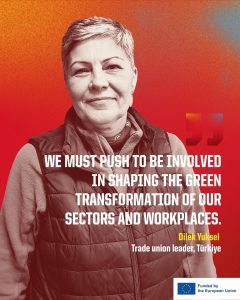
Trade union for paper and pulp industry workers
“Workers in Türkiye have so far not been allowed to participate in discussions about the transition. We must push to be involved in shaping this change within our sectors and workplaces.”
“Our primary task is to ensure that people remain employed even after the transition. In Türkiye, workers who lose their jobs risk falling below the starvation line. As a union, we must also monitor that the green transition is authentically ‘green’. For example, we need to track the chemicals used in material recycling. Workers’ health must be a priority when new working methods are introduced.”
“It is thanks to this collaboration that the green transition has become a priority on our agenda. Now, we—trade unions, environmental organizations, and researchers—are working together on an initiative we call ‘the people’s climate action’. We will demand a just transition at the Peoples’ Climate Summit, which will be organized as an alternative to COP31 to be held in Türkiye later this year.”
The Palme Center’s collaboration with trade unions in Türkiye for a just green transition is financed with support from the EU.


In Serbia, coal-dependent local communities risk having limited influence over the green transition.
When national plans began to be drawn up, there was a risk that the process would become overly technical and top-down, without sufficient consideration for jobs, local development and the people most affected.
During the year, the Palme Center’s partner organisation, the Democratic Dialogue Network (DDN), helped to change this. Together with BOŠ and CEPLOR, they brought together civil society, local authorities, experts and institutions in a joint process to promote a fairer and more inclusive transition.
There was a particular focus on the coal mining region of Lazarevac, where local stakeholders took part in focus groups and open discussions on the challenges and opportunities of the transition.
The work resulted in a policy document guiding Lazarevac’s development in the climate transition – with a focus on employment, the local economy and social sustainability. It was handed over to the municipality as a basis for future planning and decision-making.
The initiative helped to broaden the issue from a narrow expert discussion to a wider public and political process, with increased opportunities for affected people to influence their future.
Young people shapes local policy for a just transition in ColombiaIn several of Colombia’s most vulnerable regions – Amazonas, Chocó and Sierra Nevada – the natural environment is under threat from deforestation, mining and climate change.
At the same time, young people often lack the opportunity to influence the political decisions that determine their future.
The Palme Center’s partner organisation, VozEs, is working to change this by training and mobilising young environmental leaders.
In 2025, 800 young people from eight rural municipalities in Chocó took part in a training programme on the environment, democracy and political advocacy. The programme was carried out in collaboration with regional authorities and the Pedagogical University of Colombia and forms part of a wider initiative to train over 3,000 young environmental leaders in the coming years.
A key part of the work is linking the training to real political processes.
Following the training, the participants developed their own policy proposals for a green economy and presented them in dialogue with mayors, regional authorities and national ministries. Several of the ideas have already begun to be integrated into local development plans.
The initiative is particularly significant as it brought together, for the first time, eight municipalities in Chocó around a joint programme for the environment and youth participation – in a region where cooperation otherwise mainly revolves around mining and industrial projects.
Through community education methods and close collaboration with decision-makers, VozEs strengthens young people’s opportunities to influence development in their communities.
In regions characterised by poverty, conflict and organised crime, this work contributes both to protecting the Amazon and to strengthening democracy by encouraging more young people to engage in community decision-making.
Education strengthens dialogue and political cooperation in Southern AfricaIn a region characterised by polarisation, the Palme Center’s partner ETU has strengthened dialogue between political parties through education and the exchange of experiences on coalition-building ahead of elections in countries including South Africa, Namibia and Mozambique.
These initiatives provided the parties with practical tools to manage different election outcomes and prepare for cross-party cooperation.
Ahead of the elections, ETU worked closely with governing parties on scenario analysis and preparations for different outcomes, as well as training in coalition-building.
Following network meetings, concrete support was also provided on how parties could act in practice in the event of a changed political landscape.
The results have been clear.
In South Africa, the ANC quickly accepted the election result when the party received less than 50 per cent of the vote for the first time and was able to swiftly form a unity government for the first time.
In Mozambique, established channels of dialogue between youth leagues helped to keep communication open following a violent election and facilitated a national dialogue.
Through targeted support, ETU has strengthened parties’ ability to manage political differences through dialogue and cooperation.
Food handlers win right to unemployment benefits in South AfricaIn South Africa, so-called food handlers serve school meals to over nine million children every day as part of the national school feeding programme.
Despite the importance of their work, these women have long been regarded as ‘volunteers’ and have been denied access to basic rights such as unemployment benefits.
When many contracts were due to expire in 2025, the food handlers organised themselves and turned their individual struggles into a collective fight.
With support from the Palme Center’s partner organisation, the Labour Research Service (LRS), they organised protests outside employment offices (which also handle labour law and social insurance), ran social media campaigns and launched a petition.
The campaign led to tangible results.
For the first time, food delivery workers were able to access unemployment benefits. At the same time, the Department for Education removed the word ‘volunteer’ from the job title.
Broad alliance challenges power monopoly in ParaguayAhead of the upcoming local elections, the País Solidario party has played a key role in bringing together progressive, liberal and conservative forces within a broad democratic alliance in the capital, Asunción.
A total of 16 parties agreed during the year on a joint process for selecting a candidate, which reduced fragmentation and laid the groundwork for a stronger opposition.
The process required difficult compromises and the establishment of common ground rules.
Through the support of the Palme Center, including training in negotiation and alliance-building, key actors have been strengthened in their roles as candidates and negotiators.
The result marks an important step towards breaking a long-standing monopoly on power and paving the way for increased political competition, reduced clientelism and a more functional democracy in Paraguay.
Podcast gives workers a voice in Bosnia and HerzegovinaIn Bosnia and Herzegovina, issues relating to working conditions and trade union rights have long struggled to gain a foothold in the public debate. Traditional media rarely give space to workers’ perspectives.
To change this, Božo Marić, president of the Public Administration Trade Union of Republika Srpska, launched the podcast “Bez rukavica” – “Without Gloves”.
With support from the Palme Center, a new platform was created for open discussions on labour law, social justice and current political issues.
The podcast has quickly gained significant traction. Within the first 40 days, the programme had already reached around 1.5 million views on YouTube and social media.
The initiative creates a new public arena where workers, politicians and employers can engage in dialogue. It demonstrates how trade unions can make workers’ conditions more visible in the public debate.
Civil society strengthens democracy and rights in DR CongoThrough the Palme Center’s programme in the Democratic Republic of Congo, civil society has gained greater opportunities to influence policy, strengthen democracy and improve people’s living conditions.
During the 2022–2025 programme period, several partner organisations have contributed to tangible results in the areas of women’s political participation, political accountability and workers’ rights.
With support for organisational development and capacity building, the women’s organisation CAFCO has held its first general assembly in many years and trained newly elected female municipal councillors. Their advocacy work helped increase the proportion of female candidates in the 2023 election from 11.68 to 17 per cent.
The youth movements Filimbi and LUCHA have strengthened grassroots organising and developed new methods to scrutinise and hold local authorities to account.
At the same time, CODELT has contributed to important legislative reforms concerning natural resources, forests and land rights through legal expertise and strategic advocacy.
Through the partner organisation CONAFED, a new solidarity-based social security system has also been established for civil society actors and informal workers. In October 2025, representatives from civil society, trade unions and cooperatives gathered to adopt statutes and elect the leadership for the system, which covers pensions, health protection and survivor’s benefits.
Trade unions have also made progress. For the first time in many years, free and democratic trade union elections have been held in workplaces, strengthening workers’ representation and opportunities for dialogue with employers.
Together, these results demonstrate how a strong civil society can create new opportunities for democracy, social justice and citizen influence in the DRC.
