
Nyhetsbrev
Prenumerera gratis på våra nyhetsbrev och inbjudningar till seminarier.
Prenumerera gratis på våra nyhetsbrev och inbjudningar till seminarier.

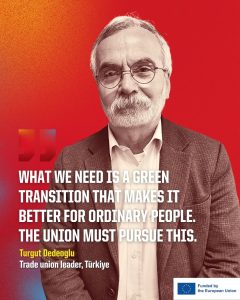
Trade union for journalists, publishing and printing house workers
“The climate crisis will affect workers the most, and we represent the workers. In addition, countries like ours are particularly vulnerable to the impacts, such as extreme heat.
Today’s politics primarily benefit those who hold capital. What we need is a green transition that improves the lives of ordinary people. Pursuing this must be the union’s mission.”
“Türkiye is a developing country. So whenever we bring up environmental issues, we are met with ‘Why do you oppose development?’. We need to communicate that this transition is fundamentally about securing jobs and protecting workers’ health.
While people in Türkiye are well aware of the climate crisis, they do not yet know what a ‘just transition’ looks like. As a union, we can help our members familiarize themselves with this concept so they can participate in how their workplaces evolve. Our own sector, the printing industry, will be heavily impacted by this transition. To get a clearer picture of the changes underway, we are currently preparing a report.
Furthermore, those of us who are journalists can directly report on the climate crisis; our roles is to inform the public. For instance, we can draw attention to laborers forced to work under extreme heat, which is becoming increasingly common. Being out in the field so much, we as media workers are also affected by this.”
“Yes. It is notoriously difficult for trade unions to put any issue on the agenda in Türkiye. However, those of us involved in this collaboration can now mobilize together ahead of the COP climate summit in our country later this year. There, we will stand up for workers’ rights to a safe and democratic transition.”
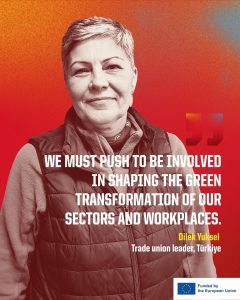
Trade union for paper and pulp industry workers
“Workers in Türkiye have so far not been allowed to participate in discussions about the transition. We must push to be involved in shaping this change within our sectors and workplaces.”
“Our primary task is to ensure that people remain employed even after the transition. In Türkiye, workers who lose their jobs risk falling below the starvation line. As a union, we must also monitor that the green transition is authentically ‘green’. For example, we need to track the chemicals used in material recycling. Workers’ health must be a priority when new working methods are introduced.”
“It is thanks to this collaboration that the green transition has become a priority on our agenda. Now, we—trade unions, environmental organizations, and researchers—are working together on an initiative we call ‘the people’s climate action’. We will demand a just transition at the Peoples’ Climate Summit, which will be organized as an alternative to COP31 to be held in Türkiye later this year.”
The Palme Center’s collaboration with trade unions in Türkiye for a just green transition is financed with support from the EU.


In Serbia, coal-dependent local communities risk having limited influence over the green transition.
When national plans began to be drawn up, there was a risk that the process would become overly technical and top-down, without sufficient consideration for jobs, local development and the people most affected.
During the year, the Palme Center’s partner organisation, the Democratic Dialogue Network (DDN), helped to change this. Together with BOŠ and CEPLOR, they brought together civil society, local authorities, experts and institutions in a joint process to promote a fairer and more inclusive transition.
There was a particular focus on the coal mining region of Lazarevac, where local stakeholders took part in focus groups and open discussions on the challenges and opportunities of the transition.
The work resulted in a policy document guiding Lazarevac’s development in the climate transition – with a focus on employment, the local economy and social sustainability. It was handed over to the municipality as a basis for future planning and decision-making.
The initiative helped to broaden the issue from a narrow expert discussion to a wider public and political process, with increased opportunities for affected people to influence their future.
Podcast gives workers a voice in Bosnia and HerzegovinaIn Bosnia and Herzegovina, issues relating to working conditions and trade union rights have long struggled to gain a foothold in the public debate. Traditional media rarely give space to workers’ perspectives.
To change this, Božo Marić, president of the Public Administration Trade Union of Republika Srpska, launched the podcast “Bez rukavica” – “Without Gloves”.
With support from the Palme Center, a new platform was created for open discussions on labour law, social justice and current political issues.
The podcast has quickly gained significant traction. Within the first 40 days, the programme had already reached around 1.5 million views on YouTube and social media.
The initiative creates a new public arena where workers, politicians and employers can engage in dialogue. It demonstrates how trade unions can make workers’ conditions more visible in the public debate.
Civil society in Albania strengthened dialogue ahead of election dayIn the run-up to the general election, civil society created new forums for interaction between voters and political candidates.
Through the POP Network, citizens were given the opportunity to ask questions directly to politicians and raise local priorities.
In ten municipalities, public forums were organised where more than 42 candidates met with over 700 citizens in direct dialogue. The discussions were broadcast live and reached over 23,000 viewers online.
The focus was on issues such as governance, transparency, social services and gender equality.
The format was based on local dialogues where residents first identified their most important issues. During the forums, they were then able to demand concrete answers from the candidates.
The initiative helped shift the election campaign from political rhetoric to substantive issues, whilst strengthening citizens’ ability to participate in democracy and hold politicians accountable.
Campaign raises awareness of the rights of blind war veterans in UkraineRussia’s full-scale war has left thousands of Ukrainians with severe injuries. One group that is often overlooked is soldiers who have lost their sight.
The Palme Center’s partner, SD Platform, has therefore launched a campaign to ensure that blind veterans receive the support and rehabilitation they need to lead a dignified life.
The organisation, which works towards a society built on freedom, justice and solidarity, highlights social issues in a context where these are often pushed into the background.
Through the campaign, SD Platform is pushing for concrete reforms: long term financial support, improved rehabilitation and access to care and rehabilitation throughout the country.
They also work to ensure that public spaces, transport and government services are accessible to people with visual impairments.
The initiative helps to raise the profile of a forgotten group – and to shape Ukraine’s reconstruction into a more inclusive society where everyone can participate on equal terms.
Breakthrough dialogue within the energy sector in North MacedoniaAs coal-fired power in the Pelagonia region is phased out, concern is growing among workers and people in local communities.
At the energy company REK Bitola, relations between management and trade union representatives have long been characterised by mistrust and uncertainty about what the transition will mean for jobs and livelihoods.
Together with the Palme Center, our partner organisation MKC Bitola created a forum for dialogue within the Local Economic and Social Councils (LESC). In 2025, representatives of company management and trade unions gathered for the first time for a joint discussion on the future energy transition.
The discussions provided a space for workers to openly voice their concerns about losing their jobs and facing reduced incomes, whilst company management acknowledged the need for better dialogue regarding the changes ahead. Experiences from other European coal regions demonstrated how a just transition can best be achieved through collaboration between companies, trade unions and the local community.
The meeting marked a clear breakthrough. The focus shifted from concerns and conflicts to how the transition can be managed collectively. As a next step, an international exchange of experiences with trade unions from other coal-mining regions in Europe is now being planned.
By establishing dialogue between workers, industry and civil society, this work contributes to a fairer climate transition in which people are given a say in their future.
From conflict to dialogue on labour law in Bosnia and HerzegovinaWhen Bosnia and Herzegovina began reforming labour law linked to EU integration, political tensions in the country simultaneously increased.
The issue of the minimum wage in particular created conflict – making trust between authorities, trade unions and civil society weak.
In May 2025, the Palme Center, together with the Forum Left Initiative (FLI), took the initiative to bring together key stakeholders in Sarajevo. During a four-day programme, politicians, trade union representatives and civil society organisations met to discuss labour law, social dialogue and labour market reforms.
The dialogue made it possible to discuss concrete solutions regarding the minimum wage, labour inspections and how the reforms could be implemented more fairly.
The initiative proved to be particularly important for the decision to raise the minimum wage to 1000 KM in 2025.
By creating a forum for open dialogue, the initiative helped to strengthen trust between the prevailing parties and create better conditions for fair labour market reforms.
Improved conditions for Albanian sanitation workersSanitation workers in Elbasan have long worked under poor conditions, with low wages and limited influence over their working conditions. Many of them belong to Roma and Egyptian minorities – and work in a sector that is often undervalued despite its crucial role in society.
Through organising and dialogue, workers, civil society organisations and trade union actors succeeded in improving conditions during 2025.
The organisation Youth Roma and Egyptian Movement (YREM) brought workers together to document the problems and formulate joint demands for fair wages and better compensation for night work. Ahead of May Day, YREM brought together Elbasan municipality, sanitation companies and trade unions to discuss the situation.
The dialogue led to concrete results – waste transport workers’ pay rose of 12.5 percent, along with a pledge of a 37.5 percent increase for day work and 50 percent for night work for street cleaners.
The agreement means better incomes for sanitation workers and marks an important step towards stronger social dialogue between workers, companies and local authorities.
Progressive summit puts Ukraine’s future on the agendaIn the midst of Russia’s full-scale war, the Palme Center’s partner SD Platform brought together European social democrats in Kyiv for the first EUkraine Summit – the largest gathering of progressive forces in Ukraine to date.
The summit marked an important step in the work to build a strong progressive movement – with the aim of forming a new political party.
The Palme Center co-organised the summit, and participated with a Swedish delegation.
By strengthening progressive forces, the collaboration helps to promote a political alternative, where reconstruction is not just about investment and infrastructure but also about democracy, social justice and human rights.
SD Platform is an important progressive voice in a political landscape long dominated by the centre and the right.
By bringing together civil society, trade unions, the public sector and academia, they are working towards a society built on freedom, justice and solidarity, and for a just reconstruction of Ukraine.
North Macedonian citizens’ demands become political commitmentsMany citizens in North Macedonia feel that solely contact with politicians rarely leads to real change. Ahead of the 2025 local elections, the Palme Center’s partner organisation, NGO Info-centre, therefore brought together over 1100 residents across six municipalities to formulate their priorities for their own local communities.
Through a structured process involving surveys, focus groups and public debates, citizens were given the opportunity to ask mayoral candidates directly how they intended to implement these demands. Post the election, the process was followed up with the newly elected mayors.
The result was a democratic breakthrough: in all six municipalities, the mayors signed formal cooperation agreements for the 2026–2029 term of office, in which they committed to working on the basis of the priorities formulated by the citizens themselves.
