
Nyhetsbrev
Prenumerera gratis på våra nyhetsbrev och inbjudningar till seminarier.
Prenumerera gratis på våra nyhetsbrev och inbjudningar till seminarier.
 ENG
ENG



Swisha ett valfritt belopp till
123 24 060 72Tack för ditt stöd!
Nu i november genomförs arbetarrörelsens internationella höjdpunkt i Stockholm!
Årets Palmedag äger rum den 12 november på Norra Latin, Stockholm. Kvällen innan – den 11 november – firar vi Palmecentrets 30-årsjubileum med mat och musik på LO-borgen i Stockholm.
Palmedagarna är en mötesplats och en bred manifestation för svensk arbetarrörelses internationella solidaritetsarbete. Lokala och regionala aktivister med intresse för globala frågor träffar varandra och centrala företrädare, diskuterar och utbyter erfarenheter.
Temat för årets Palmedagar är demokrati under attack, rättvis omställning och fred.
OBS! Deltagande kostar 150 kr. Då ingår både jubileumskvällen och Palmedagen.
För dig som via en medlemsorganisation driver ett internationellt projekt finns det också möjlighet att anmäla sig* till en utbildning på söndagen. Då ingår deltagande för hela helgen kostnadsfritt.
*Anmälan för söndagen har tyvärr redan stängt.
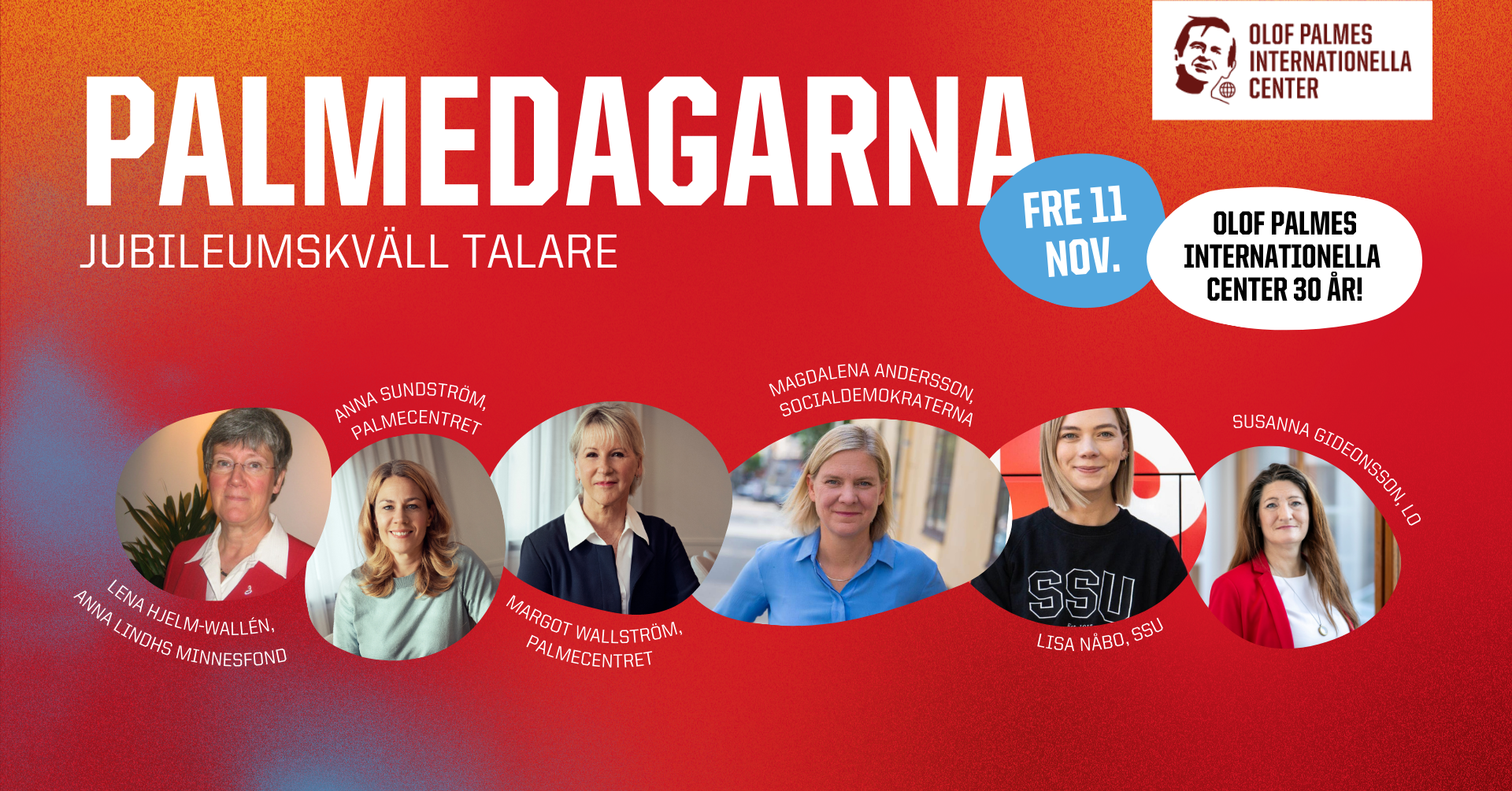
TID & PLATS: Fredagen den 11 november, kl. 16:00-21:00. LO-borgen, Barnhusgatan 18 Stockholm.
Det blir mingel och musik. Under kvällen blir det tal av Socialdemokraternas partiledare Magdalena Andersson och samtal om Palmecentrets dåtid, nutid och framtid. Kl. 17.00 hälsar Margot Wallström (Palmecentret) och Susanna Gideonsson (LO) alla välkomna.
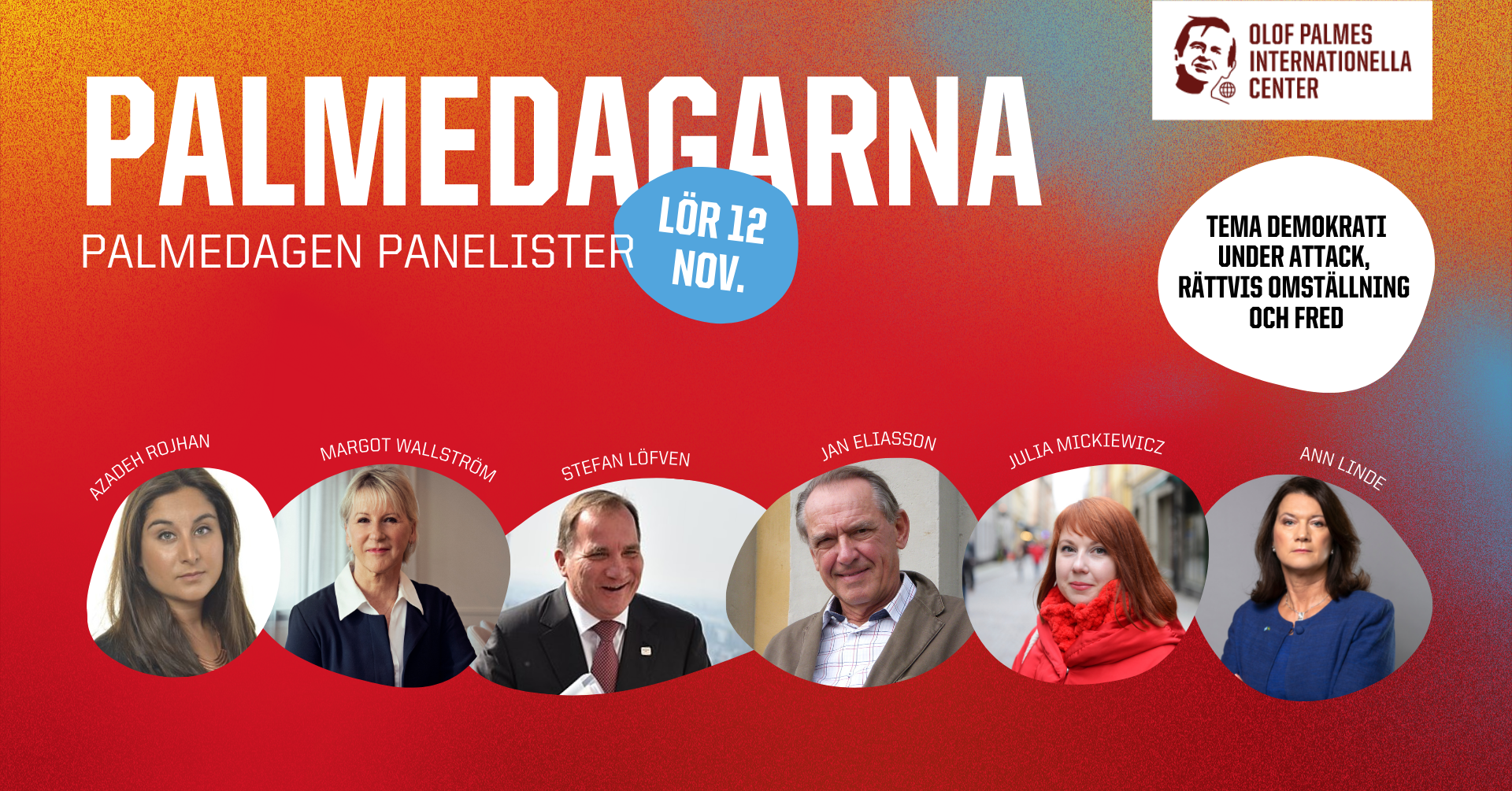
TID & PLATS: Lördagen den 12 november, kl. 10:00-16:30. Norra Latin, Drottninggatan 17b, Stockholm.
Kl. 10.30-12.15 valbara seminarier:
Kl. 12.15-13.10 lunch och musik.
Kl. 13.10-13.40: Internationellt samarbete i en tid av nationalism och polarisering, med Margot Wallström, Jan Eliasson och Stefan Löfven.
Kl. 13.50-15.40 valbara seminarier:
15.45-16.00 avslutningstal.
16.00-17.00 gemensam ljusmanifestation till stöd för den feministiska revolutionen i Iran.
Musikens och ordens makt i det nya Sydafrika
Hur får man dagens unga att känna hopp och framtidstro i ett land fyllt av korruption, arbetslöshet och fattigdom? Välkomna till ett samtal med musikkollektivet Soundz of the South från Kapstaden – om musik som verktyg för att nå landets unga befolkning och få dem att göra sina röster hörda.
”Vi är ljudet av revolution, vi formades ur elden som är det afrikanska folkets kamp. Soundz of the South ger röst åt de röstlösa, åt de fattiga och förtryckta. Soundz of the South är befrielse genom musik. Vår unika blandning av hiphop, afro och soul är mer än bara musik; det är ljudet av bojor som går sönder, det är ljudet av triumf över förtryck, det är ljudet av folket, det är ljudet från Syd.”
Samtalet leds på engelska av Nkanyiso Maqeda, Olof Palmes Internationella Center
Tid: Fredag 23 sep, kl. 13.30-14.00.
Scen: Globala Torgets studio, H-hallen, plan 1 på Bokmässan.
Arrangör: Olof Palmes Internationella Center
Globala Torget på Bokmässan i Göteborg är platsen där samtida litteratur möter aktuella världshändelser. Årets teman är Real CrimeTime (tillsammans löser vi världens värst brott!), Klimatkrisen, Sydafrika och Röster från Ukraina. Delta på plats på mässan eller följ programmet live på Facebook eller Globala Torgets hemsida.
Vad är politikernas plan för en rättvis omställning?
Sverige har snart en ny regering och riksdag, som nu kraftfullt behöver skynda på den akuta omställning av Sverige som måste till för att bromsa klimatkrisen och rädda den biologiska mångfalden.
Det civila samhället står eniga i viljan att driva på politiken i denna gemensamma fråga, och se till att omställningen blir rättvis. Att arbeta tillsammans i breda allianser och nätverk är en förutsättning för att lyckas. Palmecentret har därför tagit initiativ till Allians för rättvis klimatomställning (ARK), som välkomnar fackliga organisationer, miljörörelsen, studieförbund, kvinno- och fredsorganisationer, ungdomsorganisationer, trossamfund, med flera.
Alliansens fråga till Sveriges politiker är: Vad är er plan för att genomföra en rättvis klimatomställning av Sverige under de närmaste två mandatperioderna? Naturskyddsföreningen har gjort en kartläggning av partiernas klimatpolitik. Om den, om politikernas svar på ARK:s fråga, och om vikten av att arbeta tillsammans för att rädda vår planet, handlar det här samtalet.
Karin Lexén, generalsekreterare, Naturskyddsföreningen
Cajsa Unnbom, metodrådgivare miljö och klimat, Olof Palmes Internationella Center
Ann-Katrin Dolium, sakkunnig i frågor kring hållbart företagande, Unionen (extern expert)
Anna Sundström, generalsekreterare, Olof Palmes Internationella Center
Tid: Lördag 24 september kl.11.20-12.00.
Scen: Globala Torgets stora scen, H-hallen, plan 1 på Bokmässan.
Arrangör: Olof Palmes Internationella Center
Globala Torget på Bokmässan i Göteborg är platsen där samtida litteratur möter aktuella världshändelser. Årets teman är Real CrimeTime (tillsammans löser vi världens värst brott!), Klimatkrisen, Sydafrika och Röster från Ukraina. Delta på plats på mässan eller följ programmet live på Facebook eller Globala Torgets hemsida.
Yttrandefrihet och pressfrihet får av säkerhetsskäl ofta stryka på foten i krig. Samtidigt är det också värden som Rysslands anfallskrig mot Ukraina handlar om – rätten att skriva, rätten att kritisera makten.
I ett samtal mellan Andrej Kurkov, ordförande i ukrainska PEN-klubben, och Inga Näslund från Olof Palmes Internationella Center, får vi höra om författares och journalisters villkor under brinnande krig.
Andrej Kurkov är en ukrainsk författare, född 1961, normalt bosatt i Kiev, men befinner sig för tillfället i Lviv. Sedan 2018 är han ordförande för ukrainska PEN. Kurkov skriver även barnböcker, så samtalet kommer också att handla om barns rätt till berättelser och hur barnen i Ukraina kan läka efter kriget.
Andrej Kurkov, författare och ordförande för ukrainska PEN.
Inga Näslund, Olof Palmes internationella center
Tid: Lördag 24 sep, kl. 15.00-15.30.
Scen: Globala Torgets studio, H-hallen, plan 1 på Bokmässan.
Arrangör: Olof Palmes Internationella Center
Globala Torget på Bokmässan i Göteborg är platsen där samtida litteratur möter aktuella världshändelser. Årets teman är Real CrimeTime (tillsammans löser vi världens värst brott!), Klimatkrisen, Sydafrika och Röster från Ukraina. Delta på plats på mässan eller följ programmet live på Facebook eller Globala Torgets hemsida.
De globala hoten känns alltmer påtagliga, krig, kärnvapen, klimatförändringar, pandemier och ett ökande antal auktoritära regimer. Vår världsordning fungerar inte som den borde. Hur ska vi hantera de utmaningar som hotar hela vår mänsklighet?
Detta samtal utgår från Jan Eliassons nyligen publicerade memoarer ”Ord och handling”. Vilka lärdomar finns att hämta från en lång erfarenhet i världspolitikens centrum? Hur går vi faktiskt och praktiskt till väga för att skapa en bättre värld?
I rapporten Common Security 2022, framtagen av en internationell kommission, finns tankar och rekommendationer kring hur vi tar oss an de globala hoten utifrån begreppet gemensam säkerhet. På vilket vis kan ett 40 år gammalt koncept vara användbart i dag?
Med Jan Eliasson, tidigare vice generalsekreterare för FN, och Anna Sundström, generalsekreterare Olof Palmes Internationella Center.
Tid: Fredag 23 september, kl. 15.00-15.40.
Scen: Globala Torgets stora scen, H-hallen, plan 1 på Bokmässan.
Arrangör: Olof Palmes Internationella Center och Albert Bonniers förlag.
Globala Torget på Bokmässan i Göteborg är platsen där samtida litteratur möter aktuella världshändelser. Årets teman är Real CrimeTime (tillsammans löser vi världens värst brott!), Klimatkrisen, Sydafrika och Röster från Ukraina. Delta på plats på mässan eller följ programmet live på Facebook eller Globala Torgets hemsida.
Vi står inför enorma utmaningar. Pandemin har lett till ökad hunger och fattigdom och tagit jämställdheten bakåt flera decennier. Klimatkrisen påverkar människors vardag i detta nu och antalet konflikter ökar. Demokratin och människors rättigheter är starkt hotade på flera platser i världen.
Enligt OECD är svenskt bistånd ledande i världen när det gäller att nå människor som lever i fattigdom och utsatthet. Ändå beslutade Sveriges regering våren 2022 att skära i biståndet med en femtedel. Och det finns partier i Sveriges riksdag som har gått till val på att permanent skära ner ännu mer på biståndet.
Vad får ett minskat svenskt bistånd för konsekvenser för människor runtom i världen? Hur påverkar ett minskat internationellt samarbete världens gemensamma agenda för att bromsa klimatförändringarna, utrota fattigdomen och minska antalet konflikter? Hur ser Sveriges ansvar ut i detta?
Med:
Sibusiso (S’bu) Innocent Zikode från rörelsen Abahlali base Mjondolo i Sydafrika, och 2021 års mottagare av Per Anger priset.
Anna Tibblin, generalsekreterare We Effect
Anna Sundström, generalsekreterare Olof Palmes Internationella Center
Alan Frisk, biståndschef, Svenska Afghanistankommittén
Moderator:
Louise Lindfors, generalsekreterare, Afrikagrupperna
Tid: Fredag 23 sep, kl. 9-15-10.00.
Scen: Globala Torgets stora scen, H-hallen, plan 1 på Bokmässan.
Arrangör: Olof Palmes Internationella Center
Globala Torget på Bokmässan i Göteborg är platsen där samtida litteratur möter aktuella världshändelser. Årets teman är Real CrimeTime (tillsammans löser vi världens värst brott!), Klimatkrisen, Sydafrika och Röster från Ukraina. Delta på plats på mässan eller följ programmet live på Facebook eller Globala Torgets hemsida.
Sverige kan och ska inte vända världen ryggen. Alla kriser just nu – klimatet, ekonomin, hungern, energin, säkerheten och demokratin – är globala.
Vår tids stora frågor känner inga geografiska gränser, vilket vi mycket påtagligt märker. Därför är det viktigt med ett bibehållet och starkt bistånd.
Och det betyder att vilka vi röstar på i valet nu i september faktiskt spelar roll.
Anna Sundström, generalsekreterare Olof Palmes Internationella Center
Maria Nyberg, generalsekreterare Union to Union
Samtalet arrangeras av ABF Stockholm och Olof Palmes Internationella Center
OM VÄLJARNAS VALSTUDIO:
Inför valet 2022 öppnar ABF Stockholm en valstudio för att tillsammans med relevanta aktörer diskutera de mest brännande ämnena.
Live på Facebook 6 – 8 september från deras studio i ABF Huset. Välkommen att delta, kommentera och engagera dig inför valet!
Efter kuppförsöket 2016 har demokratin i Turkiet raserat. Landet har övergett parlamentarismen och är en exekutiv presidentrepublik sedan 2017. Makten är koncentrerad vid presidenten och en auktoritär regim har utvecklats under Erdogans ledarskap. Regimkritiker flyr utomlands. Människorättsaktivister och politiska motståndare, inte minst på den kurdiska sidan, förföljs, stämplas som terrorister och får långa fängelsestraff. Europarådet har dömt Turkiet flertal gånger för brott mot yttrandefriheten och enligt tankesmedjan Freedom House är Turkiet inte längre ett fritt land.
Samtidigt har Erdogans ekonomiska politik lett till rekordstor inflation med hög arbetslöshet, växande klyftor och polarisering. Dessutom huserar Turkiet sedan Syrien-krigets början ca 3,7 miljoner människor från Syrien, som Turkiet använder flitigt som påtryckningsmetod gentemot EU. Som Natomedlem med västalliansens näst efter USA starkaste militära styrkor är Turkiet en regional stormakt med svåra utmaningar när regeringspartiet AKP med president Erdogan i spetsen kämpar med att vara kvar vid makten även efter presidentvalet 2023.
Under seminariet kommer Turkiets utveckling att granskas och dess nära framtid analyseras.
Paul Levin, föreståndare för Institutet för Turkietstudier, Stockholms universitet,
Helin Sahin, regionchef, Menaregionen, Olof Palmes Internationella Center.
Michael Sahlin, tidigare bland annat Sveriges Turkietambassadör och Thomas Hammarberg, sakkunnig om mänskliga rättigheter, samtalsledare.
Detta är ett samarrangemang mellan ABF Stockholm, OSSE-nätverket och Olof Palmes Internationella Center.
Hotet mot Taiwan – i skuggan av UkrainaPå ön Taiwan, öster om Kina, bor 24 miljoner människor som utvecklat en fungerande och innovativ demokrati. Ett land med snabb tillväxt som utvecklar ett modernt välfärdssamhälle. Men ett allt mer aggressivt Kina hotar demokratin. Efter att demokratin i Hongkong krossats riktas nu allt mer uppmärksamhet mot Taiwan. Militära provokationer och hybridattacker är bara några av de metoder vi sett under senare tid. Kina och Ryssland har ingått ett nära partnerskap och stöttar i praktiken varandras militära ambitioner.
På kort tid har situationen i världen förändrats dramatiskt. Rysslands invasion i Ukraina, som få trodde skulle ske, är nu verklighet. Kinas agerande i Hongkong, mot Taiwan och i Sydkinesiska havet är allvarligt. Vad händer i relationen Taiwan–Kina? Och vad beror det på? Vad gör Sverige och EU för att stötta demokratin? Det är hög tid att Taiwans utsatthet uppmärksammas. Gör vi tillräckligt? Vad kan vi göra?
Seminarium i Almedalen tisdagen den 5 juli kl. 9–10.00
Folkets Bio, Adelsgatan 39, Visby – eller live på Facebook.
Vincent Yao, Taiwans representant i Sverige
Kerstin Lundgren, riksdagsledamot för Centerpartiet, sitter i utrikesutskottet
Mathias Tegnér, riksdagsledamot för Socialdemokraterna, sitter i näringsutskottet
Anna Sundström, generalsekreterare Olof Palmes Internationella Center
Håkan A Bengtsson, VD för Arenagruppen
Björn Jerdén, Chef för Nationellt kunskapscentrum om Kina
Seminariet arrangeras av Arenagruppen och Olof Palmes Internationella Center
Common Security – the way forward when our world order is failing
The world stands at a crossroads. The choice is between an existence based on confrontation, aggression and ecological disaster or one rooted in peace, sustainability and common security. Humanity faces the existential threats of nuclear war, climate collapse and pandemics.
Our world order is up against severe challenges. The common systems and structures – needed to provide security, combat poverty and inequality and prevent human suffering – are inadequate, and frequently violated. The future of humanity depends on us fixing our struggling global order.
This year marks the 40th anniversary of Olof Palme’s Independent Commission on Disarmament and Security Issues. Now Russian aggression against Ukraine is a reminder of what can happen when the world order fails. It is time to consider whether Palme’s concept of Common Security can help bring us back from the brink.
The recently launched report, Common Security 2022, shows the way forward. A High-Level Advisory Commission, a diverse group of prominent people from every continent, has contributed its knowledge and broad experience and created a document that gives us a glimpse of a better world.
The upcoming environmental conference Stockholm+50 is all about combining environmental action with the social goals of Agenda 2030. Focusing on the concept of common security can help the conference join the dots between the work for a peaceful world and the protection of our living environment.
The webinar will be in English.
Margot Wallström, former Minister for Foreign Affairs, Sweden
Cedric de Coning, Research Professor, NUPI, South Africa
Anna Sundström, General Secretary, Olof Palme International Center, Sweden
Jytte Guteland, Group of the Progressive Alliance of Socialists and Democrats in the European Parliament
The webinar is co-hosted by Olof Palme International Center, Solidar, End Ecocide Sweden, Friedrich-Ebert-Stiftung, Foundation for European Progressive Studies, IPB and ITUC.
